
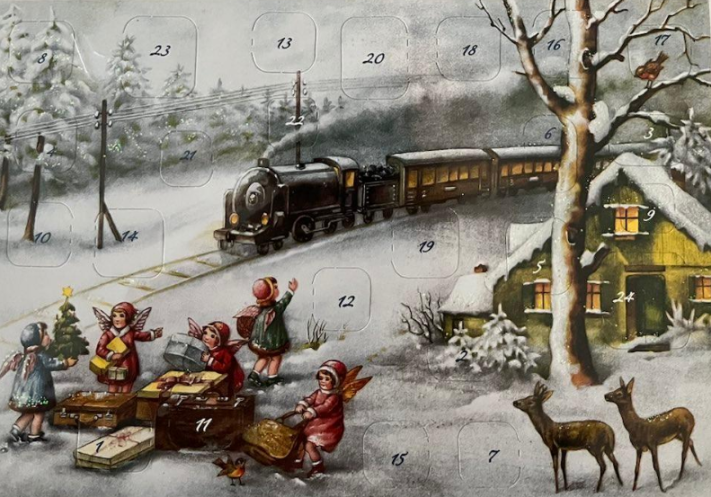
Many Advent calendars take the form of a large rectangular card with "Doors", one for each day of December leading up to and including Christmas Eve (December 24). Consecutive doors are opened every day leading up to Christmas, beginning on the start of the Advent season (on December 1). Often the doors are distributed across the calendar in no particular order. The calendar doors open (here on double-clicking) to reveal an image, a poem, a portion of a story, etc.
The first known physical calendars were handmade in Germany in 1851 and evolved in that artisan way until the turn of the 20th century, when Gerhard Lang, the father of the Advent calendar as we know it, started printing them, on thick cardboard. This was a time when many of the customs we associate with the celebration of Christmas was invented.
In 1971, the British confectioner Cadbury decided that, since only the most faith filled could be completely satisfied with a biblical countdown, they should add chocolate. They weren’t the first to do this, but they did it best, and from there the idea grew that these calendars could give you daily rewards of the material kind, as well as spiritual. The gifting experts at Harry and David took the advent calendar to a higher, more three-dimensional level, creating wooden boxes with elaborately designed compartments that contain many of their best food and wine products.
Today, more than 100 years later, the Advent calendar is still very popular. Lots of people around the world, from Christians to non-Christians still go out and purchases an Advent calendar, for either themselves or their children to count down the days until Christmas.